AFL
5 hours ago
Fitzroy's last win: Historic day the Lions dominated Freo
By Dylan Leach

Download the SEN App
Your Home of Sport, In your Hand
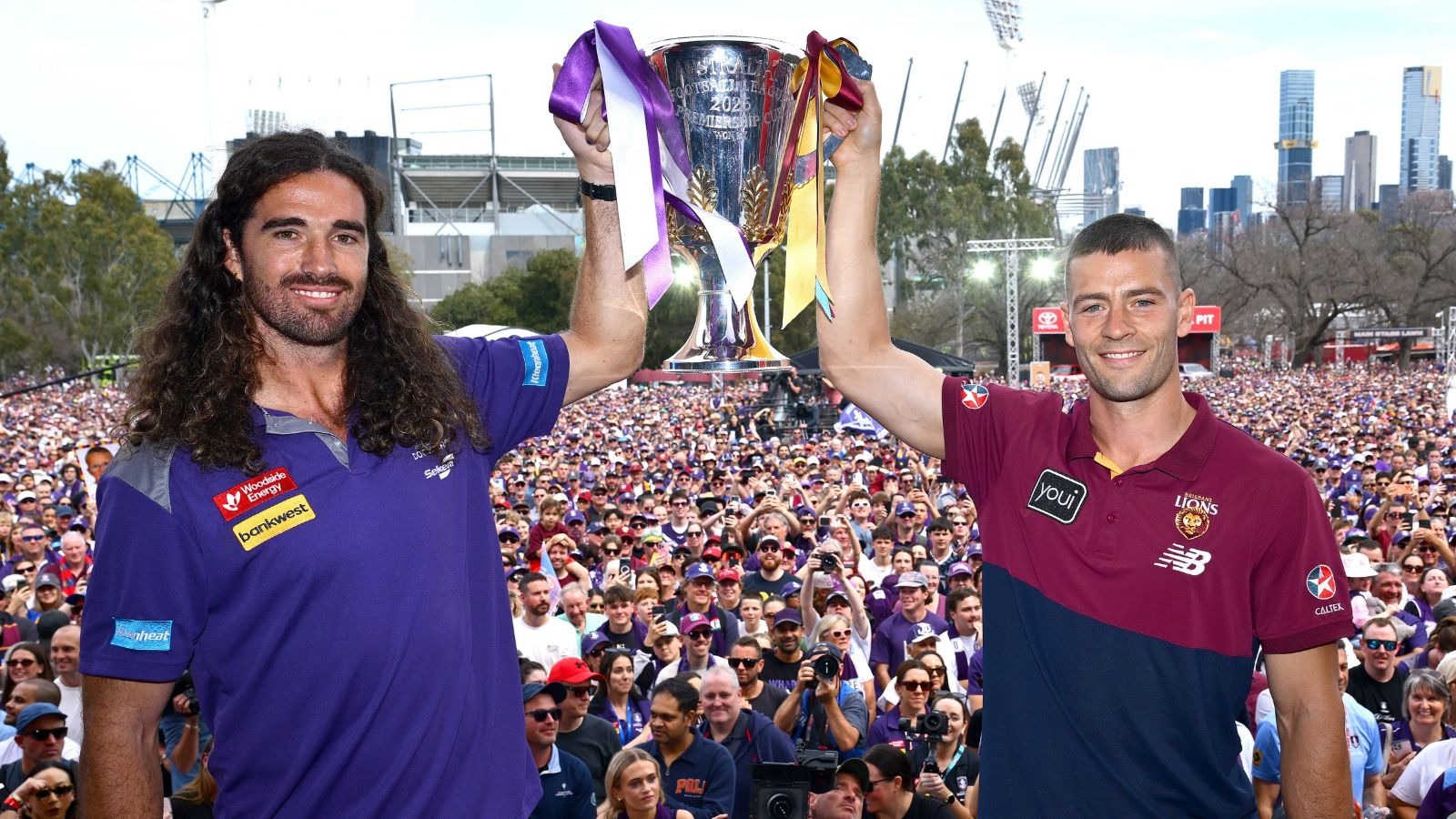
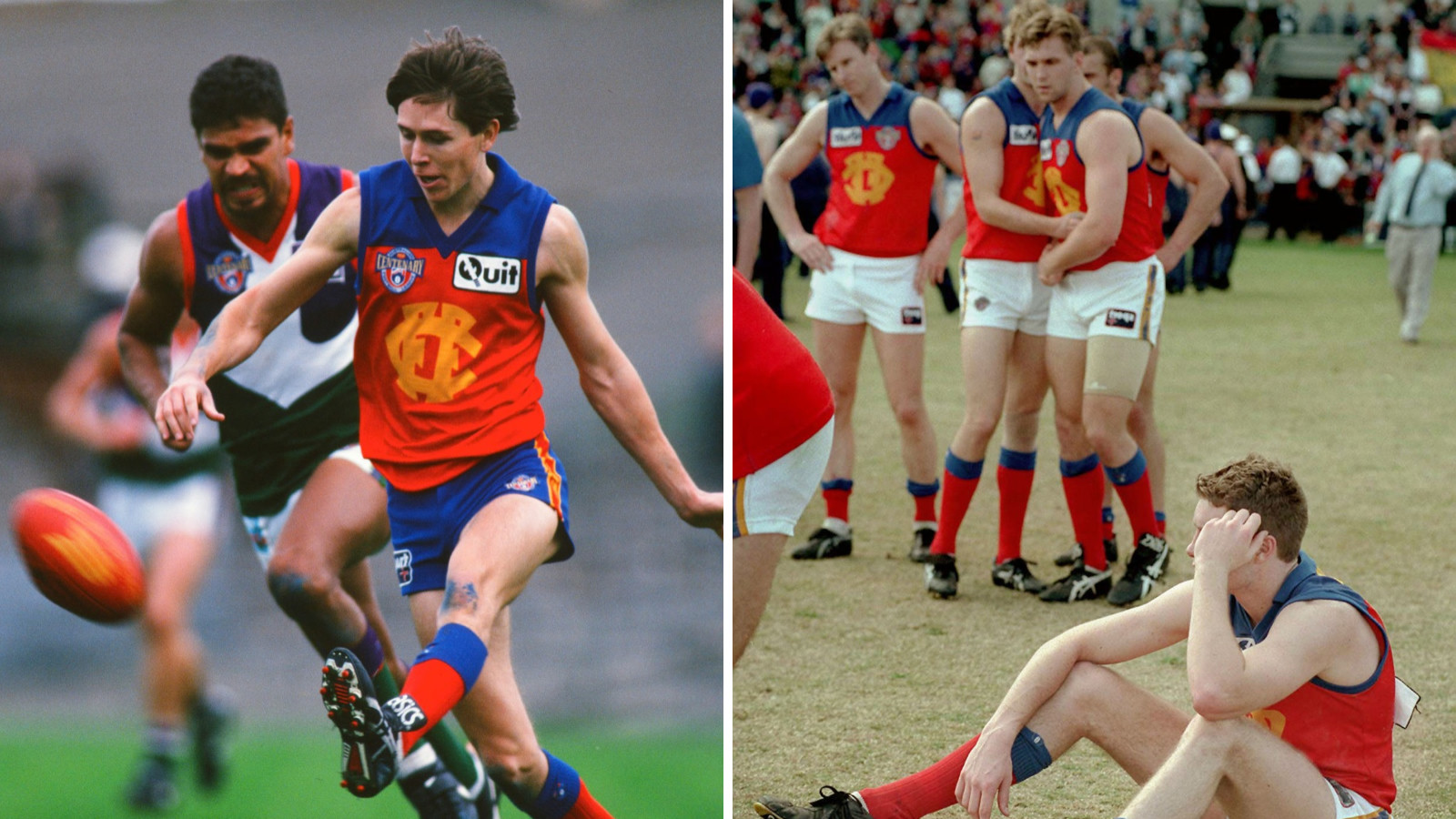
Ahead of a big Brisbane v Fremantle Grand Final on Saturday, that famous afternoon 30 years ago on when the old Fitzroy, a forebear of the Lions, won its last ever game of League football has been revisited.
Dennis Cometti delivered the line for Channel Seven just as the old dread started to creep in. Early in the last quarter, Fremantle forwards Brad Rowe, Kingsley Hunter and Tony Godden kicked three unanswered goals, and suddenly a match that had felt like a release began to feel like another test of nerve.
The winless Fitzroy had owned the afternoon. At three-quarter time, the Roys were 51 points clear. But this was Fitzroy in 1996, a club living with instability on and off the field, and as the Dockers surged there was a familiar unease in the air — the suspicion that the expected script might still reassert itself.
It was Saturday, May 18, 1996 — round eight of the AFL’s centenary season - a date that sits in football history with an ache all of its own.
It had been 364 days since Fitzroy last won.
The previous week, The Sunday Age had revealed Fitzroy and North Melbourne were in serious merger discussions, and this time there was no meaningful denial. Fitzroy president Dyson Hore-Lacy confirmed that eight clubs had shown interest, with North Melbourne the preferred partner.
The future felt as if it was being negotiated somewhere else, by other people, in other rooms.
Seven’s coverage reflected that reality. The pre-game talk was less about match-ups than boardroom manoeuvring. Cometti crossed to a Talking Footy clip of coach Michael Nunan admitting the speculation had become “a total distraction”, and even at half-time, with Fitzroy in control, the merger remained central to the conversation.
In Perth that week, Cometti had been characteristically blunt writing in The West Australian, that he did not have “a great deal of sympathy for Fitzroy’s plight” while also warning that the game had “danger game written all over it” for Fremantle, which came into the game off a 96-point loss to Adelaide six nights earlier, a five-day break and back-to-back trips east – scheduling that never would be tolerated today.
The Dockers opened at $1.17 in today’s terms, while Fitzroy was paying $6. Then the market shifted. By Friday, the Roys had shortened to around $4.50. A few Friday tipsters in the papers were prepared to go with them too, among them a young and apparently wise Ashley Browne in The Age.
Inside the rooms, 19-year-old Chris Johnson, in his 45th senior game for the Lions, could sense the shift as well.
At Fitzroy that week, everyone was living in that faintly ridiculous zone between hope and self-protection — a little like Lloyd Christmas in Dumb and Dumber.
“So, you’re telling me there’s a chance.”
Only this time, the chance felt tangible.
“There’s a spring in your step when you think you’re a chance,” Johnson recalled. “Training was sharper. There was more talk. You could feel something.”
Small Crowd, big noise
Only 5083 people made their way to the Whitten Oval that grey, overcast afternoon.
The terraces were thinly populated. The wind came in across Barkly Street. Fitzroy, technically the home side, still looked slightly displaced in Footscray, as if the club had already begun to be edged away from the spaces that once defined it.
But the people who did turn up were not casuals. They were the rusted-on faithful.
As author William Westerman recounted in Merger – The Fitzroy Lions and the Tragedy of 1996, supporters arrived carrying placards that doubled as protest and prayer.
“AFL Help The Roy Boys – I’d Like To See That.”
“Let Fitzroy Cubs Become Lions.”
“Lions will blitz in 1996.”
Behind the Footscray Road goals stood 15-year-old Tim Jenkinson and his mate Lee, close enough to the action to become part of the rhythm of the day.
John Rombotis kicked one early. Johnson snapped truly. Anthony Mellington marked strongly and converted from long range. The ball kept coming back to the fence line, and with it came the first stirrings of belief.
“We reckon we had 11 touches throwing the ball back between us,” Jenkinson laughs now. “Got to know (Fremantle defender) Scotty Chisholm pretty well.”
When Darren Holmes — forever linked in football folklore to tackling the pig at the SCG in 1993 as a Swan — was concussed by Peter Mann’s leading elbow, the boos arrived instantly. Mann was reported, and the crowd’s mood sharpened further.
Holmes was taken off on a stretcher. Later, captain Brad Boyd strained a hamstring.
The bench got shorter. Fitzroy’s spirit did not and by half-time, the home team led by 28 points.
Then came the moment that seemed to capture everything absurd, desperate and affectionate about the club’s situation. It was reported that one supporter somehow got onto the PA system at Whitten Oval and urged fans to chip in $2000 each to help save Fitzroy.
It drew laughter, cheers and a ripple of applause — a gallows-humour fundraiser in the middle of a football match.
Word appeared to spread beyond the ground. More supporters drifted in, some arriving after hearing the score on the radio and deciding they needed to be there if something unlikely was unfolding.
“You didn’t want to say it out loud in the outer,” Jenkinson said. “But we all thought … maybe.”
The premiership quarter
With the wind at their backs to the Footscray Road end, Fitzroy produced the kind of third quarter that struggling teams dream about and so rarely deliver with goals to Johnson, Brad Cassidy (twice), Shane Morton and to Johnson again.
The margin blew out to 51 points, and for once the scoreboard did not feel misleading. The Roys were not surviving; they were dictating.
Mellington, in only his 12th senior game, would finish with six goals. Matthew Primus fought manfully in the ruck. Scott Bamford ran and ran. Nick Carter marshalled things with a calmness that seemed to exceed his years.
It was startling. The Lions were in charge of the game, and just as importantly, of the mood inside the ground.
Holding firm
Inevitably, Fremantle pushed back, which led to Cometti’s aforementioned observation.
No one needed the reminder. Earlier in the year, leads had leaked away. Fitzroy supporters had every reason to fear the familiar.
This time, though, the line held.
Out of defence the move began: Jarrod Molloy to John Barker, Barker to Primus. Bamford gathered, linked up with Simon Hawking and then sent the ball long to the square where Mellington fumbled, regathered and snapped a goal.
“That’s when we knew we were home,” Johnson said.
The siren
When the final siren sounded, the formal second siren that was supposed to let supporters onto the ground was unnecessary. They were already streaming across the grass.
“It was just joy,” Johnson said. “No sadness. Just joy.”
On the boundary, Seven’s Neil “Knuckles” Kerley tried to interview John McCarthy, who was playing his 150th game, but the moment dissolved into a crush of jubilant supporters. Kerley later appeared on camera wearing a Fitzroy scarf as the club song rolled around Whitten Oval.
In the press conference afterwards, Nunan kept his footing.
“The worst fear I have is that people treat this win as some sort of Grand Final,” he said. “Good teams do this every week and that’s the target one needs to set.”
That night, Channel Seven crossed live to the Albion Charles Hotel in Northcote, Fitzroy’s social club, where the scenes suggested Nunan’s warning was always going to be ignored. They were celebrating exactly as if a Grand Final had been won — and who could have blamed them?
“You couldn’t get into the place,” Johnson says. “They got us through the back door and up onto the stage. The supporters were going crazy. Absolutely nuts.”
For a few hours at least, the merger talk receded into the background.
Melbourne’s loss to Hawthorn across town lifted Fitzroy off the bottom of the ladder.
For one week, the Roys sat 15th.
THE OTHER SIDE
For Fremantle coach Gerard Neesham, the day carried its own sting.
“We played very poorly,” he said. “But they also played pretty well. Mick Nunan was a really clever coach. He didn’t have the cattle overall, but he had the cattle on the day they played us.”
“To be the only side at that point to have lost to Fitzroy was pretty devastating.”
But memory has a way of softening a result when the human context is large enough.
After the siren, one of Neesham’s old mates — by then a barramundi fisherman in the Gulf of Carpentaria — found him on the ground, draped in Fitzroy colours and standing alongside his mum.
“He said, ‘It’s the first AFL game I’ve ever seen live. I’ve followed them all my life and they won.’”
Neesham pointed out that he had coached the losing team.
“He said, ‘Yeah, I know. That doesn’t matter. I won. Mum won.’”
Neesham still smiles at the memory.
“You’re filthy about losing and they’re just over the moon.”
With distance, he has come to see the result a little differently. “I’m glad they won,” he said. “It’s a more honourable thing than having a whole season of losses.”
FOR ONE DAY
Fitzroy would not win again in 1996, nor ever again.
Less than six weeks later, the club entered administration. The merger with the Brisbane Bears soon followed. The Lions saw out the season, but there were no more victories.
Ironically, the very next Friday night brought North Melbourne at the MCG and a 105-point loss.
When asked whether the players sensed another opening later that season, Johnson does not romanticise it.
“No. We’d be two or three goals down at quarter-time, then they’d pump on six or eight.”
There was no late-season revival waiting around the corner. The win over Freo would be it.
At school the following Monday, Tim Jenkinson walked a little taller. Classmates who did not even barrack for Fitzroy patted him on the back.
As the Coodabeen Champions noted in song, deep down, everyone barracked for Fitzroy and for one weekend it felt completely true.
“It felt like the whole footy world was happy for us,” said Jenkinson, who these day follows the Brisbane Lions.
“That day just sticks with you,” he says. “It was ours.”
FITZROY v FREMANTLE: A SHORT BUT SIGNIFICANT HISTORY
As the Brisbane Lions prepare to take on Fremantle this weekend, it’s worth remembering how brief, yet strangely significant, the Fitzroy–Dockers history was.
The two clubs met just four times.
Three of those games carry genuine historical weight:
● Round 3, 1995 – Fremantle’s first-ever AFL win, a 43-point victory over Fitzroy at the Whitten Oval.
● Round 8, 1996 – Fitzroy’s final AFL victory, defeating the Dockers by 31 points in what would become the Lions’ last roar.
● Round 22, 1996 – Fitzroy’s final AFL match, played against Fremantle at Subiaco Oval. Fremantle by 86 points.
Like many looking back, even Gerard Neesham still questions why Fitzroy was forced to play its last game in Perth given the significance of the occasion.
“It was ludicrous,” he says. “A famous Victorian club playing its last game in a foreign state. I’m positive if they had asked us to play it in Melbourne, we would have.”
What Fremantle could control, it handled with care.
After the final siren, an opera singer performed Auld Lang Syne high in the stands at Subiaco Oval, the song drifting across the ground in a haunting farewell as the Dockers formed a guard of honour and the Fitzroy players walked off to the rooms with the Roys club song blaring over the PA.
“I’ve forever felt proud of my club,” Neesham said. “The way Fremantle managed that exit was incredible. As honourable a job as any club could do in that circumstance.”